


- 15
- 07
- 2026

- 07.00
- pm
Ragged University Presents Schrödinger’s Tortoise – What St Helena Tells Us About Tnformation, Technology and Learning Systems with Drew Whitworth
- £FREE
- Buy Tickets
Come along to Gullivers at 7pm on Wednesday 15th July for some company, some small bites of food and a talk by Drew Whitworth on ‘Schrödinger’s Tortoise – What St Helena tells us about information, technology and learning systems’. Everyone is invited to bring along an item of food to put on the table, eat what they like and help take away what is left at the end.
At 194 years old, Jonathan the giant tortoise is the world’s oldest known land animal, resident in the gardens of Plantation House on St Helena island, in the south Atlantic. For a while on 1 April 2026, as far as the rest of the world was concerned, like Schrödinger’s Cat he was both dead and alive, as a hoax X post announced his demise. The story went viral around the world’s broadcast, print and social media before anyone thought to ‘fact check’ it: eventually a phone call from a newspaper to the Governor of St Helena confirmed that Jonathan remained alive and well.
This story illustrates several things. Digitisation has made the sphere of information global, pervasive and volatile, and drawn even the most remote places on Earth (St Helena is 1,200 miles from the nearest continental land) into immediate contact with everywhere else, at least potentially. Yet just because St Helena has enjoyed high-speed broadband internet access since the activation of the Equiano undersea cable in October 2023, that does not mean the local community retains any significant control over how it is presented and positioned in these global information flows. Like all small communities, it is subject to the whims of those who control these networks, and the values and ways of thinking that are encoded into the hardware and software technologies that allow them to function. And the island remains, and will always remain, remote: both in a geographical but also a social sense.
Yet St Helena has not always been so peripheral. For 175 years (1659 – 1834) it was in the hands of the East India Company, acting as a crucial node in a vast mercantile trading operation. The Company sponsored scientific enterprise (Edmond Halley, Charles Darwin and Joseph Banks all conducted research there) and used the island as a way-station for valuable botanical specimens. When Napoleon was exiled there after Waterloo it is no exaggeration to say that it became one of the most famous places in the world for a few years, with information about the former Emperor in great demand. After the EIC lost their monopoly and St Helena became a UK colony (now Overseas Territory), in 1899 the island was connected to its first undersea telegraph cable a mere six weeks after the outbreak of the Boer War prompted the development.
But what this history illustrates is how these information and communication technologies are never installed alongside an associated learning system that facilitates their adoption into community life. Technologies have not, and still do not, generate capital for places like St Helena: they have been installed to extract it. While it has become much easier for St Helenians to stay in touch with events elsewhere, this has also increased the ‘pull factor’, with Jonathan’s island suffering a noticeable decline in population in the 2020s. What will be the fate of this community, and those in other remote and peripheral places, in the face of these technological and social trends?
Drew Whitworth has worked at the University of Manchester since 2005, and helped launch the MA: Digital Technologies, Communication and Education in 2007, acting as its first Programme Director. He has so far published three books about the relationship between ICT and learning: Information Obesity (2009), Radical Information Literacy (2014) and Mapping Information Landscapes (2020). His study of St Helena began in 2021, and as a result of this work he is now the webmaster of the Friends of St Helena and sits on the committee of that organisation.
He grew up in Sussex but, after turning up in Yorkshire for six weeks in 1991, finds himself still there. He has been known to express his liking for cinema, football, hiking and beer — the last three often all at the same time, where possible.
You May Also Be Interested In
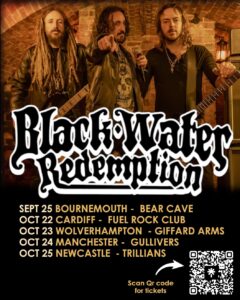
Black Water Redemption
With guests Bad Heritage